
Rose Harsent // Peasenhall
Episode One script // Epitaph East Anglia Podcast

This is the episode script for Episode One of the Epitaph: East Anglia podcast. I release these scripts alongside each episode, for those that prefer to read rather than listen. We also include some photos along the way!
-
This week we visit to the Suffolk village of Peasenhall, where we find ourselves standing at the grave of Rose Harsent. A simple grey stone cross, that was once white but now weathered and dressed in lichen. It feels a little lonely out here. The cemetery sits on the outskirts of the village and although many graves bear freshly laid flowers, I imagine Rose out here alone, looking toward the heart of the village where her name was so well known for a time. Nevertheless, this is where Rose was laid to rest one hundred and twenty two years ago.
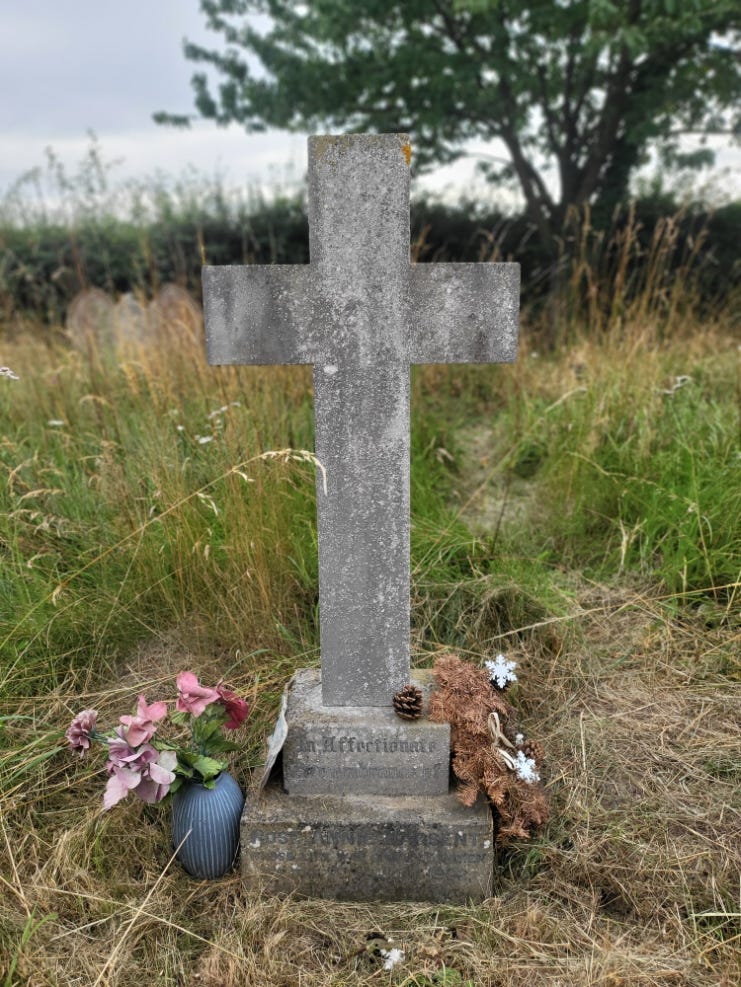
The year is 1902. A storm had raged all night and its early morning on the 1st of June. William Harsent arrives at Providence House, by way of the back door from the garden. He had been intending to deliver some linen to his daughter Rose, who was a domestic servant at the house. Instead, he steps into the kitchen to find the body of Rose at the bottom of the stairs to her attic room. Her throat had been cut and charring made it seem like someone had tried to set fire to her nightdress. A broken bottle of paraffin attested to this. The alarm was raised and so began the first moments of one of this county’s most enduring mysteries.
Despite this horrific scene, the initial assumption was that Rose has somehow committed suicide. Upon examination of her body however, it was then determined to be an act of murder. It was also found that she was some six months into pregnancy.
Notes were found among her possessions, including one to indicate that she had been planning to meet someone that night. It read ‘ Dear Rose, I wil try to see you tonight at twelve o’clock at your place. If you put a light in your window at ten o’clock for about ten minutes then you can take it out again. Don’t have a light in your room at twelve o’clock as I will come round the back in the light.’
The first and most likely suspect was William Gardiner. He was a prominent member of the local community, though not necessarily free from scandal or universally popular. He was foreman at the local seed drill works, which was only a short distance away from Providence House, as was the home he shared with his wife and six children. He was also choirmaster at the Primitive Methodist Chapel, where Rose was sometimes given the task of cleaning.
A year previously a scandal had broken out when two men started a rumour that they had heard intimate conversations between Rose and William while in the chapel. William, who was many years her senior, had at that time been outraged at the audacity of the accusation. He threatened to sue those making the accusations and a Primitive Methodist church investigation ensued, which resulted in the matter being dropped, if not forgotten.
When it was found that Rose had been murdered while pregnant suspicion quickly fell on William and he was arrested. There was circumstantial evidence a-plenty and witnesses that claimed to have seen him outside his house on the evening before the crime – perhaps waiting and watching a certain window in Providence House.
The handwriting on Rose’s notes were determined to be in William’s hand and the envelope matched to ones he used at the Seed Drill works. A broken medicine bottle by her body was labeled with instructions ‘For Mrs Gardiner’s children’. All of this certainly tied the Gardiner’s to the scene, but no one could place him in the house at the time of the crime.
He went to trial in November 1902 and all the evidence and witnesses were presented. Mrs Gardiner stated that her husband had not left the house that night and it had actually been herself who had passed the medicine bottle to Rose some weeks earlier. The trial brought forward a neighbor of Rose’s called Frederick Davis. William’s defence implied that he had been ‘close’ to Rose and while he admitted that he had also written her somewhat inappropriate letters, he claimed he could not have been the father of Rose’s child. He had, he confessed, supplied her with risqué poetry on her request and sourced a booklet on techniques to end a pregnancy, but he only did these things in the hope of winning her favour. She never did reciprocate his feelings. Whilst there seemed to be a lot of evidence pointing to William being guilty, the jury could not agree on a verdict. It afterward emerged that it had been an eleven to one stalemate in favour of a guilty verdict. Prior to 1974 all jurors need to agree on the verdict, however today a majority of 10 out of 12 votes is enough to secure a verdict.
Gardiner’s second trial then commenced in January 1903. Much of the evidence was the same as the first trial, with a few minor changes to witness statement, notably from Rose’s own brother. He had initially denied delivering letters between the two, but now admitted that he had done so. The defense at second trial relied much more on sentimentality and there was much more emphasis on Mrs Gardiner and her situation in defending her husband. William Gardiner’s standing in the church community was again highlighted and ultimately, there still was no evidence placing him at the scene during the hours of murder.
So once again the jury retired and once again they could not agree on a verdict. This time however, the majority were for acquittal. It was decided that a third trial would be equally ineffective and so a ‘writ of nolle prosequi’ was issued. Essentially this is a legal procedure that allows prosecutors to voluntarily end a criminal case when unwilling to pursue it further. William Gardiner remains one of few people to have sat through two trials with no verdict ever being returned.
William Gardiner was released on 29th January 1903, having spent almost 240 days in custody. To avoid a public outcry, the news of his release day was never announced and so he slipped quietly out of prison and on to London. His family would join him there and they never returned to Peasenhall. He died, never formally acquitted of Rose’s murder, in 1941.
To this day, no one has ever been convicted of Rose’s murder and it remains, officially at least, unsolved. There have, over the years, been other theories put forward. Most notably that Mrs Gardiner could have killed her out of jealousy or that her mischievous neighbour Frederick had some role in the crime, but I think the most reasonable assumption is that which was made at the time. William, knowing the child was his and what further scandal would undoubtedly come out on its birth, killed Rose and relied on his status in the village to protect him. Whether he went with the intention of killing her that night, or whether he lost control of his temper when she told him her attempt at an abortion had failed, we will never know. I suspect had he been a labourer or tradesman, and not someone respected in the church community, his first trial would have gone very differently.
As for Rose, let’s remember her as a lively young woman with an enquiring mind. Perhaps she enjoyed the excitement of being alone around someone like William, clearly a man wielding some confidence and local respect in his community. Perhaps she was just incredibly naive and thought he would choose her over his wife. We will never know what conversations were had between them or what promises were made by either party.
Rarely do we get to truthfully start a tale with ‘it was a dark and stormy night’, but the here we could. On this stormy Summer night a two lives were taken, for let’s not forget her unborn child as we stand in front of Rose’s grave in Peasenhall cemetery.
The inscription upon it reads:
In affectionate remembrance of Rose Annie Harsent.
Whose life was cruelly taken on the 1st June 1902 in her 23rd year.
A light is from our household gone.
A voice we loved is stilled;
A place is vacant on our home.
That never can be filled.
If you wish to visit the grave of Rose and her unborn baby, the what three words location is roughly ///unearthly.trails.gliders . There have been lots of books written about this case and we have listed the sources used in the telling of this story on our website normaexplores.com.
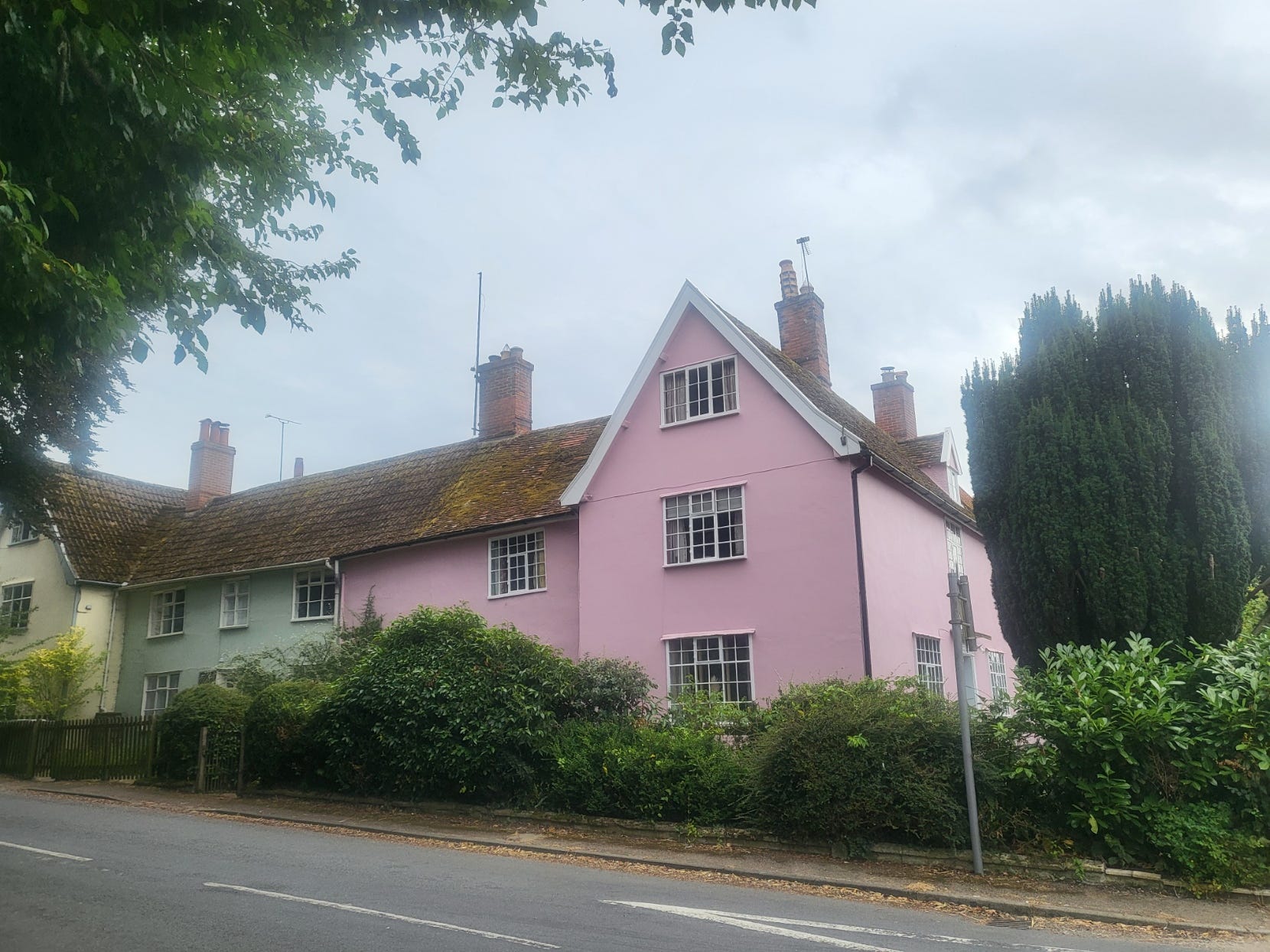
Providence House is now called Stuart House and sits on the corner opposite Emmett’s Store in the village. Emmett’s has been trading since 1820 and would have been here in operation at the time of the crime. If you walk from Providence House up along Church Street, you will shortly come to a new housing development around a street called Smyth Close. You may notice a blue plaque on a wall by the road. This reminds us this it was once the site of the seed-drill works, and in our story, it was where William was employed as foreman. William and his family lived in Alma Cottage, a small terrace on The Street located at ///encodes.suffice.glare. I would remind everyone that these are private dwellings, so if you find yourself in the village and want to see these places, please be respectful of the residents.
We hope you’ve enjoyed this stop in a Suffolk cemetery. . You can find further information on our website normaexplores.com where we have listed the sources used in this episode. We’d like to offer a big shout out to our Patreon supporters who enable us to continue creating the Norma Explores archive and allow us to produce all the content you find on our socials. Members get free downloads of our quarterly magazine, behind the scene updates, and bonus content. Tiers start at just £3 per month, but if you just want to stay in touch please join us as a free member and see what it’s all about! Please join us in two weeks’ time when we will venture into another churchyard and tell another tale behind another… epitaph.
-
Postscript
A curious twist occurred in the tale two years later when the papers were awash with reports of a confession! Many papers picked up on the story and it was widely reported that an Artilleryman named Taylor, currently imprisoned in Dover Military Prison made a voluntary confession. He stated that he had committed the crime and that it had been weighing on him ever since. He was in prison for enlisting with fraudulent papers, though this wasn’t his first stint in the lock-up. He had enlisted in the Peasenhall area in 1903 and as such would have likely been very familiar with the events of the previous year. The Coventry Evening Telegraph reported on 15th August 1904 that ‘A Daily Chronicle representative interviewed Mrs Gardiner, the wife of the man who was twice tried on the charge of murdering Rose Harsent at Peasenhall and who was then released. Mrs Gardiner has since conducted a confectionary business at Southall, where her husband works at his trade as a Carpenter. When she heard of the reported confession at Dover, Mrs Gardiner exclaimed, “What it means to us should this turn out the truth!” She continued: “our name cleared, and, more than that, the names of our five poor children!” She added, “I am afraid I can’t let you see Mr Gardiner. He is very far from well, and the doctor was very strict in his instructions not to let him be excited. This news coming so suddenly, is very exciting for him.” Ultimately, however, the Press representative was granted a few minutes interview. “There really seems some hope that there is some truth in the report.” Said Mr. Gardiner. “It seems too good to be true. But I have prayed that the truth may be brought to light. I’ve always felt it would, but the suspense is dreadful.”
Nothing else came of this confession. Two policemen came down from Suffolk and interviewed him, but left feeling he was just repeating information he had seen in the news and did not have unique insight into the crime itself. The governor of the military prison said he suspected it was a rouse because he wanted to get out of his commitment to the military. Personally, I think there are better ways to get out of the military than confessing to a brutal murder, but we really don’t know much about the individual. I would have liked to learn more about this chap, but unfortunately very little useful information was shared in the press at the time. He wasn’t seriously considered as a suspect, but part of me wants to know what happened to him.
Of the other people that feature in this story, I sometimes wonder about the two men that initiated the rumours of having heard inappropriate conversations between Rose and William. William Wright was wheelwright and Alphonso Skinner a Whitesmith. They both worked for the seed-drill works and actually shared a residence. Alphonso Skinner was a boarder at the Wright household, and it’s easy to imagine how these two could while away their evenings over a beer, contriving trouble for a foreman they didn’t like. At 21 and 25 respectively, they were probably bored, unwed, and who knows, perhaps one or other of them had their own advances toward Rose rejected. It’s speculation, as much was in this case, but people can be very petty in such circumstances.
Alphonso would go on to marry the following year, eventually passing away in 1960 while living in Basingstoke. He was 86.
William, on the other hand, seems to have died just two years later in June 1904, although I can find little information as to the circumstances. Still, at just 23 years old, it is sadly a very young age to go.
Rose’s infatuated young neighbour Frederick James Davis was 19 at the time. He and Rose are both shown in the 1901 census, with Rose at Providence House, which was listed on The Street and Frederick’s family living at the first house listed on Rendham Road. Today, Rendham Road is what Church Street turns into once you get past the site of the old seed-drill works. Frederick is listed as a draper’s assistant on the census and was described as a shop assistant in the newspapers of the time. The letters he wrote to Rose were so explicit that they could not be read in court, but copies were provided to the jury for perusal. I do wonder how they would hold up again the average dating app message inbox today. At the time they were quite a scandalous set of notes and the papers seemed to delight in this part of Rose’s character. The fact that Rose had kept the notes and not destroyed them presumably meant that she was a willing recipient, as Frederick had implied. I don’t know what happened to Frederick after the trial. I hope he was able to put the scandal and the trial behind him, unless of course, he had been involved in the crime. We will never now know the full facts of that night. It will remain one of Suffolk’s great mysteries.


Join me next time for another graveyard tale from East Anglia…..